TRT, or testosterone replacement therapy, raises testosterone toward a healthy physiologic range in men with symptoms and clinically confirmed low testosterone. When treatment is appropriate, it may improve sexual desire, body composition, mood, anemia, and bone density. Changes appear gradually, and energy, focus, erectile function, and physical performance do not improve equally for every patient.
TRT is not a general anti-aging treatment or a shortcut to higher performance. It is a prescription therapy for appropriately evaluated patients, and the decision to start depends on symptoms, repeat lab results, medical history, fertility goals, and provider review.
What TRT Actually Does in Your Body
Testosterone’s Role in Men’s Health
Testosterone is produced primarily in the testes after signals travel from the hypothalamus and pituitary gland. Luteinizing hormone (LH) stimulates testosterone production, while follicle-stimulating hormone (FSH) supports sperm production.
Testosterone contributes to:
- Sexual desire and reproductive function
- Muscle protein synthesis and lean mass
- Fat distribution
- Red blood cell production
- Bone growth and maintenance
- Mood and aspects of well-being
- Development and maintenance of male sexual characteristics
Testosterone levels often decline with age, but the pattern varies substantially. Longitudinal research has estimated that total testosterone may decline by about 0.8% per year, while free testosterone may fall faster. Health, weight, medication use, sleep, and lifestyle can influence that trajectory. Research from the Massachusetts Male Aging Study found that these age-related changes were not identical across testosterone measurements.
Low testosterone is also more common than many men realize. In one study of 2,162 men age 45 and older visiting primary care practices, 836 had a total testosterone result below 300 ng/dL. That is approximately 39%, although a low laboratory value alone does not establish symptomatic hypogonadism or prove that TRT is needed.
What Happens When Levels Drop
Some men with lower testosterone have few noticeable symptoms. Others experience reduced libido, fewer spontaneous erections, fatigue, declining strength, loss of lean mass, increased body fat, low mood, or reduced motivation.
These symptoms are not unique to low testosterone. Sleep apnea, thyroid disorders, depression, medication effects, diabetes, nutritional deficiencies, high stress, and inadequate sleep may create a similar pattern.
For that reason, major clinical guidelines recommend diagnosing hypogonadism only when relevant symptoms occur together with consistently low testosterone. Providers generally confirm a low result with repeat morning testing and evaluate the cause before discussing treatment.
When TRT is prescribed, exogenous testosterone supplements what the body is producing. The goal is to restore levels toward an appropriate range while monitoring symptoms, laboratory markers, and possible side effects.
The Core Benefits Men May Notice on TRT
TRT does not affect every symptom in the same way. Evidence is strongest for certain sexual symptoms and body-composition changes in men with confirmed hypogonadism. Other outcomes, including energy and cognition, are more variable.
Energy and Fatigue
Some men report more consistent energy after beginning TRT, but fatigue is one of the least specific low-testosterone symptoms. Treatment may help when testosterone deficiency is genuinely contributing to the problem, yet it cannot correct fatigue caused by untreated sleep apnea, thyroid disease, depression, anemia from another cause, or poor sleep.
The Testosterone Trials illustrate this distinction. Testosterone treatment did not produce a significant improvement in the primary vitality outcome, although it produced small improvements in mood and depressive symptoms.
This is why a responsible provider looks beyond the testosterone number. If fatigue remains after hormone levels improve, the next step is to investigate other causes, not simply keep increasing the dose.
Libido and Sexual Function
Sexual desire is one of the areas most likely to improve when a man has both low testosterone and related symptoms. TRT may increase libido, sexual activity, and, in some men, erectile function.
In the Testosterone Trials, treatment increased sexual activity, sexual desire, and erectile function in older men with unequivocally low testosterone. More recent TRAVERSE sexual-function data found improvements in sexual activity, desire, and hypogonadal symptoms, but not erectile function itself. Read the 2024 sexual-function analysis.
That difference matters. Erections depend on blood flow, nerve function, cardiovascular health, medication use, psychological factors, and relationship context. TRT may support sexual health when low testosterone is part of the problem, but it is not a universal erectile dysfunction treatment. Some patients may need a separate evaluation or an option such as TriMix therapy when clinically appropriate.
Muscle Mass and Body Composition
Testosterone plays a role in maintaining lean mass and regulating fat distribution. In men with hypogonadism, TRT commonly increases fat-free mass and may reduce fat mass over time.
Changes in body composition do not mean TRT replaces training, nutrition, recovery, or adequate protein intake. A prescription can correct a hormone deficiency, but the visible result still depends heavily on daily habits..
Men approaching midlife may also benefit from reading about the broader benefits of hormone replacement therapy for men over 40, including the role of sleep, exercise, and medical monitoring.
Mood, Focus, and Mental Clarity
Men often describe low testosterone as feeling less driven, less mentally sharp, or less like themselves. TRT may support mood or well-being in some men with confirmed deficiency, but claims about dramatic cognitive improvement go beyond the evidence.
Clinical trials have found small mood improvements in some populations, while benefits for memory and broader cognitive function remain uncertain. Mental fog may also be connected to poor sleep, chronic stress, depression, medication use, or metabolic health.
A realistic goal is not instant mental transformation. It is to correct a confirmed deficiency, monitor how the patient responds, and investigate other contributors when symptoms continue.
Bone Density and Long-Term Health
Testosterone and estradiol both contribute to male bone health. Untreated hypogonadism can be associated with lower bone mineral density, and TRT may increase bone density over time, particularly in men who begin with low levels.
Bone changes are slower than changes in libido or mood. Research suggests that meaningful increases may take one to two years, and improved bone density has not been proven to ensure fewer fractures. A two-year trial found increased volumetric bone density, while researchers noted that the effect on fracture prevention still requires further study.
TRT should therefore be viewed as one part of long-term care. Resistance training, adequate calcium and vitamin D, nutrition, fall prevention, and appropriate bone screening still matter.
What Does HCG Do for Men on TRT?
Human chorionic gonadotropin, or HCG, acts similarly to LH. It can stimulate the testes to produce intratesticular testosterone even when exogenous testosterone has reduced the body’s natural LH signal.
A provider may consider HCG for men on TRT who want to:
- Support testicular function
- Reduce testicular shrinkage
- Preserve intratesticular testosterone
- Maintain fertility potential
TRT can suppress sperm production because external testosterone reduces signaling through the hypothalamic-pituitary-gonadal axis.
Low-dose HCG used alongside TRT can help preserve semen parameters, but HCG does not ensure fertility. Men who want biological children should discuss that goal before starting TRT. A semen analysis, fertility-preserving alternative, or specialist referral may be more appropriate depending on timing and baseline fertility.
HCG is a prescription medication. Whether it belongs in a treatment plan depends on the patient’s goals, labs, medical history, and provider judgment.
What Does DIM Do for Men on TRT?
DIM, or 3,3’-diindolylmethane, is a compound formed from substances found in cruciferous vegetables such as broccoli, cabbage, and Brussels sprouts. It is sold as a dietary supplement and is often marketed for “estrogen balance.”
Some men take DIM during TRT because a portion of testosterone is converted into estradiol through the aromatase enzyme. However, strong clinical evidence that DIM reliably controls estradiol or improves TRT outcomes in men is limited.
DIM is not equivalent to a prescription aromatase inhibitor. It should not be presented as a proven substitute for anastrozole, and neither product should be added automatically because estradiol rises on a lab report.
Men need estradiol for bone health, sexual function, and other physiologic processes. Suppressing it too aggressively may create new symptoms. Providers should base estrogen-management decisions on symptoms, laboratory trends, dose, treatment response, and the full clinical picture.
If estradiol-related symptoms or abnormal trends develop, the first step may involve reviewing the testosterone dose or dosing schedule. A provider may consider other options only when clinically justified. Tell your care team about every supplement you take because supplements can have side effects, quality differences, and medication interactions.
What Does Clomid Do for Men on TRT?
Clomid is the brand name for clomiphene citrate, a selective estrogen receptor modulator (SERM). It blocks estrogen feedback at the hypothalamus and pituitary, which may increase LH and FSH signaling and encourage the testes to produce more of their own testosterone.
For men, clomiphene is used off-label. It is generally better understood as an alternative to exogenous TRT for selected patients, particularly men who want to preserve fertility, rather than a routine medication added to every TRT protocol.
A systematic review found that clomiphene improved testosterone levels and symptoms in many men with hypogonadism, with relatively few reported adverse effects. The available studies still varied in quality and duration.
Clomiphene and TRT work differently:
- TRT supplies testosterone from outside the body.
- Clomiphene stimulates endogenous hormone signaling.
- TRT commonly suppresses LH, FSH, and sperm production.
- Clomiphene may maintain or increase LH, FSH, and sperm production in suitable patients.
Clomiphene is not FDA-approved for male hypogonadism. It also is not a generic “post-cycle” solution that should be taken without medical supervision. A licensed provider must determine whether TRT, clomiphene, HCG, or another approach matches the patient’s diagnosis and fertility goals.
How Long Does TRT Take to Work?
There is no single TRT timeline that applies to every man. The starting level, treatment method, dose, adherence, overall health, and symptom being measured all affect when changes may appear.
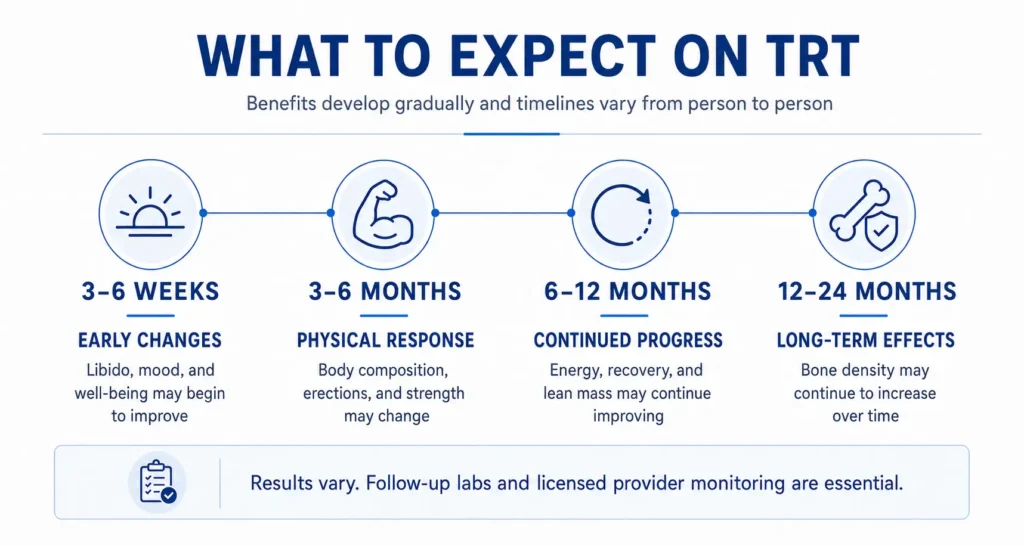
A commonly cited review reported the following general pattern:
- Around 3 to 6 weeks: Sexual interest, mood, or quality-of-life changes may begin.
- Up to 3 to 6 months: Erectile changes, body-composition changes, and some strength-related effects may become more noticeable.
- Around 3 months and beyond: Changes in red blood cell production become measurable and require monitoring.
- 6 to 12 months: Body composition may continue changing when treatment is combined with consistent training and nutrition.
- 12 to 24 months: Bone-density improvements may continue developing.
This timeline is an estimate, not a promise. Some men notice certain changes earlier, others later, and some symptoms do not respond because testosterone was not the only cause.
Follow-up labs are essential even when a patient feels better. They help the provider assess testosterone and estradiol levels, hematocrit, PSA when appropriate, and other health markers. Dose changes should be based on the combined clinical picture, not on chasing the highest possible testosterone number.
Is TRT Right for You? How We Evaluate Patients
TRT may be considered when a man has symptoms consistent with testosterone deficiency and repeat laboratory testing confirms low testosterone. A lower number without symptoms, or symptoms with normal testosterone, may point toward a different plan.
An evaluation may include:
- Symptom and medical-history review. Your provider asks about energy, libido, erections, mood, sleep, strength, fertility goals, medications, and existing conditions.
- Baseline laboratory testing. Testing commonly includes total testosterone and may include a CBC, metabolic markers, estradiol, PSA, free testosterone, LH, FSH, lipids, or thyroid markers based on clinical need.
- Risk and fertility discussion. TRT may not be appropriate for every patient. Men planning children need to discuss sperm suppression before treatment.
- Individual treatment decision. If TRT is prescribed, the medication, dose, and schedule are selected according to the patient’s clinical picture.
- Ongoing monitoring. Follow-up labs and provider communication help assess response and identify side effects or markers that need attention.
Long-term safety depends on appropriate patient selection and monitoring.
Premier Hormone Health offers fully online TRT evaluation, no hidden fees, medications from regulated pharmacy partners, and unlimited provider messaging. Every prescription requires review and approval by a licensed medical provider.
Start with a free consultation
Conclusion
TRT is not designed to turn normal aging into a diagnosis or push testosterone beyond a healthy range. Its purpose is to address a confirmed deficiency under medical supervision.
The right question is not only “What does TRT do for men?” It is, “Are my symptoms and lab results consistent with low testosterone, and is TRT the right option for my health and goals?”
Premier Hormone Health provides a 100% online evaluation process, transparent pricing with no hidden fees, licensed medical providers, and ongoing messaging support.
Schedule your free consultation
This article is for informational purposes only and does not constitute medical advice. Testosterone, HCG, clomiphene, anastrozole, and other prescription therapies require evaluation and approval by a licensed medical provider. Individual results vary.
Frequently Asked Questions About TRT for Men
What does TRT do for men with low testosterone?
TRT supplements testosterone in men with symptoms and clinically confirmed low levels. It may improve libido, sexual activity, lean mass, body composition, mood, anemia, and bone density, although individual responses vary.
How quickly does TRT work?
Some men notice changes in libido, mood, or well-being within three to six weeks. Body composition, erections, strength, and bone density generally take longer, often several months to two years depending on the outcome.
What does HCG do for men on TRT?
HCG acts similarly to LH and stimulates testicular testosterone production. Providers may use it to support testicular function or fertility potential, but it does not ensure preserved fertility.
What does DIM do for men on TRT?
DIM is a supplement marketed to support estrogen metabolism. Evidence that it reliably manages estradiol in men on TRT is limited, so it should not replace lab-guided evaluation or prescribed treatment.
What does Clomid do for men on TRT?
Clomid stimulates the body’s own LH and FSH signaling and may raise endogenous testosterone. It is more commonly considered an off-label alternative to TRT for selected men, especially when fertility preservation matters, rather than a routine TRT add-on.
Does TRT cause infertility?
TRT can significantly suppress sperm production and may cause temporary or prolonged infertility. Men who want children should discuss semen testing, HCG, clomiphene, or other fertility-preserving options before starting.
Is TRT safe long-term?
TRT can be used long term in appropriately selected patients with ongoing medical monitoring. Risks may include elevated hematocrit, acne, reduced fertility, edema, worsening sleep apnea, and prostate-related monitoring needs. Safety depends on the individual, dose, follow-up, and health history.
Can I start TRT online?
Yes. Premier Hormone Health offers telehealth consultations, lab coordination, provider review, treatment when approved, and ongoing monitoring through an online process. A prescription is never automatic and requires medical evaluation.
Medically reviewed by:

This content has been medically reviewed by Kathleen Mishak : Nurse Practitioner